


Retrieve similar cases#
Find the cases most similar to a query, check whether the query is close enough to trust them, and recommend an action.
import matplotlib.pyplot as plt
import numpy as np

from milia.data import profiles, synthetic
from milia.recommend.action import CaseRecommender
from milia.recommend.retrieval import KNNRetriever

BLACK, GREY, OCHRE = "#111318", "#8E887D", "#C47F2C"
hours = np.linspace(0, 24, 48, endpoint=False)

population = synthetic.generate(meters=80, days=90, steps=48, noise=0.35)
shapes = np.asarray(profiles.shape(population.pivot))
actions = population.labels  # the action that was taken on each past case
past, new = np.arange(60), np.arange(60, 80)
The nearest cases#
retriever = KNNRetriever(n_neighbors=3).fit(shapes[past], np.zeros(len(past)))
query = 65
distances, positions = retriever.index_.kneighbors(shapes[[query]])
nearest = past[positions[0]]
nearest, distances[0].round(3)
(array([47, 11, 56]), array([0.143, 0.152, 0.158]))
fig, axes = plt.subplots(1, 3, figsize=(8, 2.2), sharey=True)
for place, (ax, case, distance) in enumerate(zip(axes, nearest, distances[0], strict=True), start=1):
    ax.plot(hours, shapes[query], color=OCHRE, lw=1.2, alpha=0.7)
    ax.plot(hours, shapes[case], color=BLACK, lw=2)
    ax.set(title=f"{place}: distance {distance:.2f}", xlabel="Hour")
    ax.spines[["top", "right"]].set_visible(False)
plt.show()
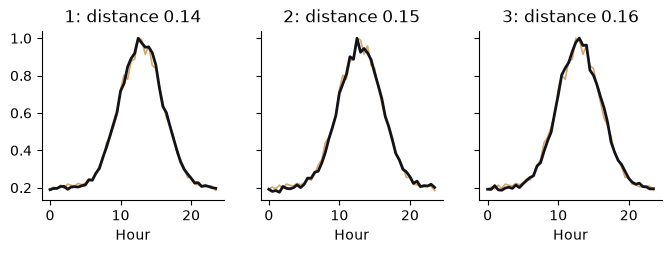
Is the query close enough?#
The retriever is calibrated on held-out cases. Its trust radius is the distance that most held-out cases fall within, and a query beyond it is reported as not trusted.
retriever = KNNRetriever(n_neighbors=3).fit(shapes[past[:45]], actions[past[:45]].astype(float))
retriever.calibrate(shapes[past[45:]], alpha=0.1, y=actions[past[45:]].astype(float))
trusted = retriever.trusted(shapes[new])
round(float(retriever.tau_), 3), int(trusted.sum()), len(new)
(0.203, 20, 20)
Recommend an action#
recommender = CaseRecommender(n_neighbors=3).fit(shapes[past], actions[past])
suggested = recommender.predict(shapes[new])
float((suggested == actions[new]).mean())
1.0
The share of new cases for which the suggested action is the one that the synthetic population assigns. Compare any
retrieval with a baseline such as GroupMean before relying on it.