Anthony Faustine
  • Home
  • About
  • Blog
  • Research
  • Email
  • GitHub
  • LinkedIn
Categories
All (13)
disaggregation (4)
dissagregation (2)
forecasting (4)
innovation (1)
iot (2)
load recognition (3)
low voltage network (3)
low voltage networks (1)
machine learning (10)
mlops (1)
nilm (6)
probabilistic (4)
strategy (1)
technology (1)
water quality (2)
wsn (2)
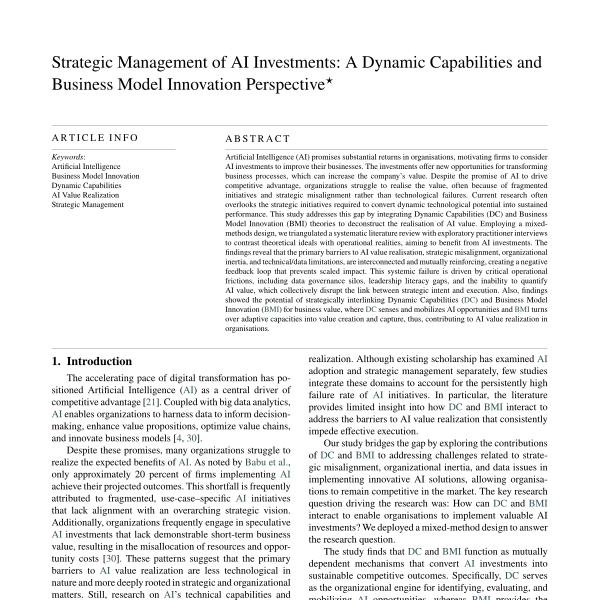
Strategic Management of AI Investments: A Dynamic Capabilities and Business Model Innovation Perspective
2025
Journal
Submitted
Anthony Faustine, Ethna O Connor, Dr Tupokigwe Isagah, and Dr Kevin Byrne

Strategic Management of AI Investments: A Dynamic Capabilities and Business Model Innovation Perspective

Journal of Strategic Information Systems

Artificial Intelligence (AI) promises substantial returns in organisations, motivating firms to cons ... ider AI investments to improve their businesses. The investments offer new opportunities for transforming business processes, which can increase the company’s value. Despite the promise of AI to drive competitive advantage, organisations struggle to realise its value, often because of fragmented initiatives and strategic misalignment rather than technological failures. Current research often overlooks the strategic initiatives required to convert dynamic technological potential into sustained performance. This study addresses this gap by integrating Dynamic Capabilities (DC) and Business Model Innovation (BMI) theories to deconstruct the realisation of AI value. Employing a mixed-methods design, we triangulated a systematic literature review with exploratory practitioner interviews to contrast theoretical ideals with operational realities, aiming to benefit from AI investments. The findings reveal that the primary barriers to AI value realisation, strategic misalignment, organisational inertia, and technical/data limitations, are interconnected and mutually reinforcing, creating a negative feedback loop that prevents scaled impact. This systemic failure is driven by critical operational frictions, including data governance silos, leadership literacy gaps, and the inability to quantify AI value, which collectively disrupt the link between strategic intent and execution. Also, findings showed the potential of strategically interlinking Dynamic Capabilities (DC) and Business Model Innovation (BMI) for business value, where DC senses and mobilizes AI opportunities and BMI turns over adaptive capacities into value creation and capture, thus contributing to AI value realization in organisations.

strategy innovation technology
Full details
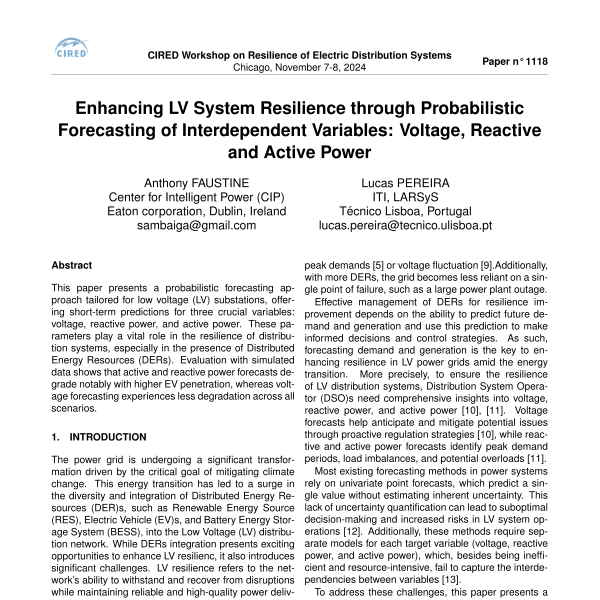
Enhancing LV system resilience through probabilistic forecasting of interdependent variables: voltage, reactive and active power
2025
Conference
Published
Anthony Faustine and Pereira, Lucas

Enhancing LV system resilience through probabilistic forecasting of interdependent variables: voltage, reactive and active power

CIRED Chicago Workshop 2024: Resilience of Electric Distribution Systems

This paper presents a probabilistic forecasting approach tailored for low voltage (LV) substations, ... offering short-term predictions for three crucial variables: voltage, reactive power, and active power. These parameters play a vital role in the resilience of distribution systems, especially in the presence of Distributed Energy Resources (DERs).

forecasting probabilistic machine learning low voltage network
Full details PDF Link DOI
Featured
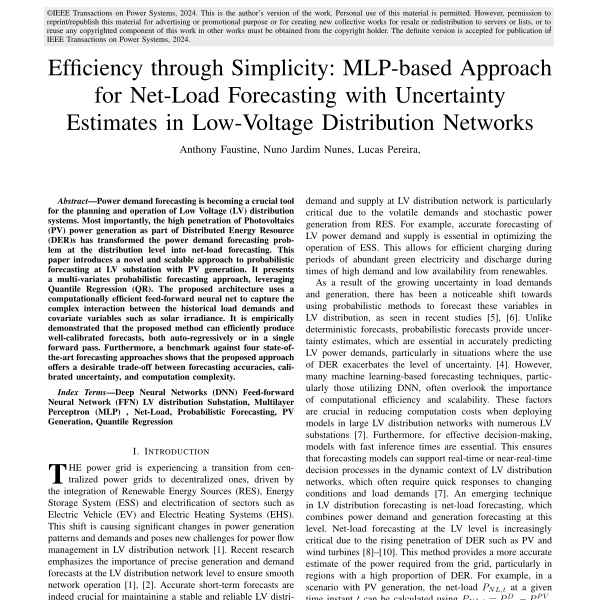
Efficiency through Simplicity: MLP-based Approach for Net-Load Forecasting with Uncertainty Estimates in Low-Voltage Distribution Networks
2025
Journal
Published
Anthony Faustine and Nuno Jardim Nunes and Lucas Pereira

Efficiency through Simplicity: MLP-based Approach for Net-Load Forecasting with Uncertainty Estimates in Low-Voltage Distribution Networks

IEEE Transactions on Power Systems , Vol. 40, No. 1 , pp. 46-5

Power demand forecasting is becoming a crucial tool for the planning and operation of Low Voltage (L ... V) distribution systems. Most importantly, the high penetration of Photovoltaics (PV) power generation as part of Distributed Energy Resource (DER)s has transformed the power demand forecasting problem at the distribution level into net-load forecasting. This paper introduces a novel and scalable approach to probabilistic forecasting at LV substations with PV generation. It presents a multi-variates probabilistic forecasting approach, leveraging Quantile Regression (QR). The proposed architecture uses a computationally efficient feed-forward neural net to capture the complex interaction between the historical load demands and covariate variables such as solar irradiance. It is empirically demonstrated that the proposed method can efficiently produce well-calibrated forecasts, both auto-regressively or in a single forward pass. Furthermore, a benchmark against four state-of-the-art forecasting approaches show that the proposed approach offers a desirable trade-off between forecasting accuracies, calibrated uncertainty, and computation complexity.

forecasting machine learning probabilistic low voltage networks
Full details PDF Slide Link DOI
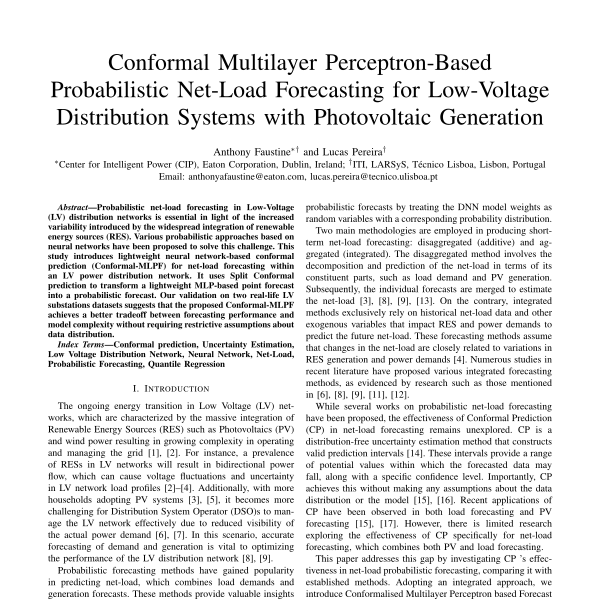
Conformal Multilayer Perceptron-Based Probabilistic Net-Load Forecasting for Low-Voltage Distribution Systems with Photovoltaic Generation
2024
Conference
Published
Anthony Faustine and Pereira, Lucas

Conformal Multilayer Perceptron-Based Probabilistic Net-Load Forecasting for Low-Voltage Distribution Systems with Photovoltaic Generation

2024 IEEE International Conference on Communications, Control, and Computing Technologies for Smart Grids (SmartGridComm), Oslo, Norway

This paper presents a probabilistic forecasting approach tailored for low voltage (LV) substations, ... offering short-term predictions for three crucial variables: voltage, reactive power, and active power. These parameters play a vital role in the resilience of distribution systems, especially in the presence of Distributed Energy Resources (DERs).

forecasting probabilistic machine learning low voltage network
Full details PDF Slide Link DOI
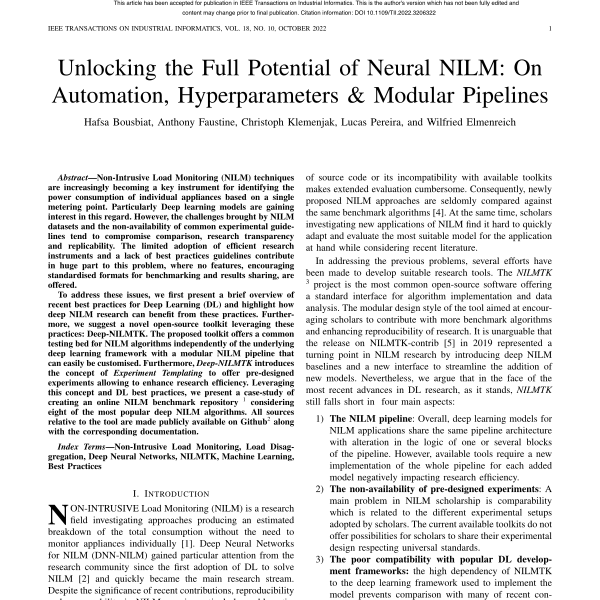
Unlocking the Full Potential of Neural NILM: On Automation, Hyperparameters and  Modular Pipelines
2023
Journal
Published
Hafsa Bousbiat, Anthony Faustine, Christoph Klemenjak, Lucas Pereira and Wilfried Elmenreich

Unlocking the Full Potential of Neural NILM: On Automation, Hyperparameters and Modular Pipelines

IEEE Transactions on Industrial Informatics , Vol. 19, No. 5 , pp. 7002-7010

Nonintrusive load monitoring (NILM) techniques are increasingly becoming a key instrument for identi ... fying the power consumption of individual appliances based on a single metering point. Particularly, deep learning (DL) models are gaining interest in this regard. However, the challenges brought by the NILM datasets and the nonavailability of common experimental guidelines tend to compromise comparison, research transparency, and replicability. The limited adoption of efficient research instruments and lack of best practices guidelines contribute in huge part to this problem, where no features, encouraging standardized formats for benchmarking, and results sharing are offered. To address these issues, we first present a brief overview of recent best practices for DL and highlight how deep NILM research can benefit from these practices. Furthermore, we suggest a novel open-source toolkit leveraging these practices, i.e., Deep-NILMTK. The proposed toolkit offers a common testing bed for NILM algorithms independently of the underlying deep learning framework with a modular NILM pipeline that can easily be customized. Furthermore, Deep-NILMTK introduces the concept of experiment templating to offer predesigned experiments allowing to enhancing research efficiency. Leveraging this concept and DL best practices, we present a case study of creating an online NILM benchmark repository1 considering eight of the most popular deep NILM algorithms. All sources relative to the tool are made publicly available on Github2 along with the corresponding documentation.

nilm machine learning mlops disaggregation
Full details PDF Link Code DOI
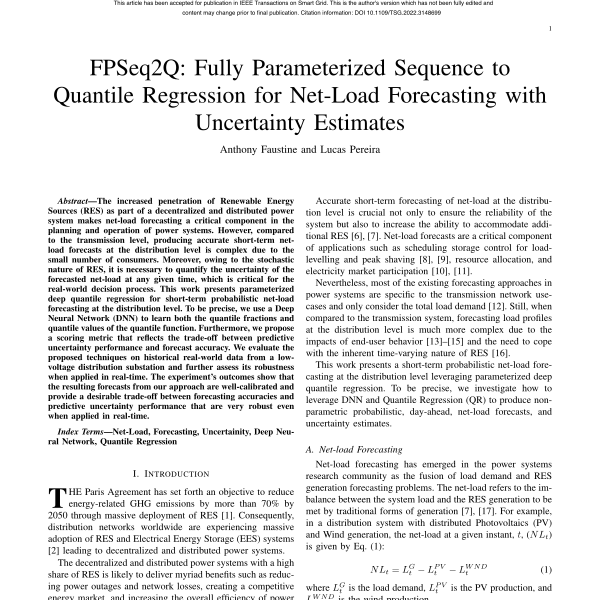
FPSeq2Q: Fully Parameterized Sequence to Quantile Regression for Net-Load Forecasting With Uncertainty Estimates
2022
Journal
Published
Anthony Faustine and Pereira, Lucas

FPSeq2Q: Fully Parameterized Sequence to Quantile Regression for Net-Load Forecasting With Uncertainty Estimates

IEEE Transactions on Smart Grid , Vol. 13, No. 3 , pp. 2440-2451

The increased penetration of Renewable Energy Sources (RES) as part of a decentralized and distribut ... ed power system makes net-load forecasting a critical component in the planning and operation of power systems. However, compared to the transmission level, producing accurate short-term net-load forecasts at the distribution level is complex due to the small number of consumers. Moreover, owing to the stochastic nature of RES, it is necessary to quantify the uncertainty of the forecasted net-load at any given time, which is critical for the real-world decision process. This work presents parameterized deep quantile regression for short-term probabilistic net-load forecasting at the distribution level. To be precise, we use a Deep Neural Network (DNN) to learn both the quantile fractions and quantile values of the quantile function. Furthermore, we propose a scoring metric that reflects the trade-off between predictive uncertainty performance and forecast accuracy. We evaluate the proposed techniques on historical real-world data from a low-voltage distribution substation and further assess its robustness when applied in real-time. The experiment’s outcomes show that the resulting forecasts from our approach are well-calibrated and provide a desirable trade-off between forecasting accuracies and predictive uncertainty performance that are very robust even when applied in real-time.

forecasting machine learning probabilistic low voltage network
Full details PDF Link Code
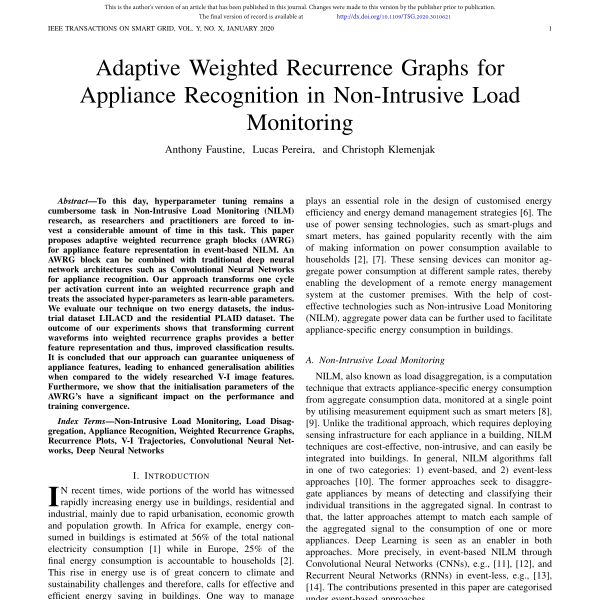
Adaptive Weighted Recurrence Graphs for Appliance Recognition in Non-Intrusive Load Monitoring
2021
Journal
Published
Anthony Faustine and Pereira, Lucas and Klemenjak, Christoph

Adaptive Weighted Recurrence Graphs for Appliance Recognition in Non-Intrusive Load Monitoring

IEEE Transactions on Smart Grid , Vol. 12, No. 1 , pp. 398-406

To this day, hyperparameter tuning remains a cumbersome task in Non-Intrusive Load Monitoring (NILM) ... research, as researchers and practitioners are forced to invest a considerable amount of time in this task. This paper proposes adaptive weighted recurrence graph blocks (AWRG) for appliance feature representation in event-based NILM. An AWRG block can be combined with traditional deep neural network architectures such as Convolutional Neural Networks for appliance recognition. Our approach transforms one cycle per activation current into an weighted recurrence graph and treats the associated hyper-parameters as learn-able parameters. We evaluate our technique on two energy datasets, the industrial dataset LILACD and the residential PLAID dataset. The outcome of our experiments shows that transforming current waveforms into weighted recurrence graphs provides a better feature representation and thus, improved classification results. It is concluded that our approach can guarantee uniqueness of appliance features, leading to enhanced generalisation abilities when compared to the widely researched V-I image features. Furthermore, we show that the initialisation parameters of the AWRG's have a significant impact on the performance and training convergence.

nilm load recognition machine learning disaggregation
Full details PDF Link Code DOI
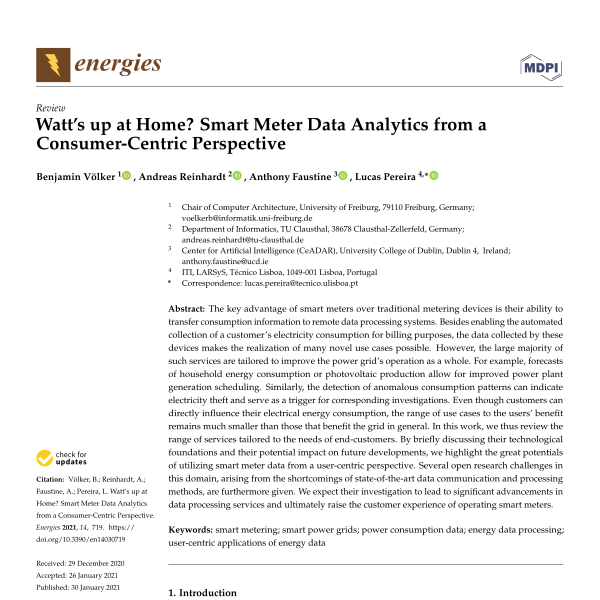
Watt’s up at Home? Smart Meter Data Analytics from a Consumer-Centric Perspective
2021
Journal
Published
Völker, Benjamin, Reinhardt, Andreas, Anthony Faustine and Pereira, Lucas

Watt’s up at Home? Smart Meter Data Analytics from a Consumer-Centric Perspective

Energies , Vol. 14, No. 3

The key advantage of smart meters over traditional metering devices is their ability to transfer con ... sumption information to remote data processing systems. Besides enabling the automated collection of a customer’s electricity consumption for billing purposes, the data collected by these devices makes the realization of many novel use cases possible. However, the large majority of such services are tailored to improve the power grid’s operation as a whole. For example, forecasts of household energy consumption or photovoltaic production allow for improved power plant generation scheduling. Similarly, the detection of anomalous consumption patterns can indicate electricity theft and serve as a trigger for corresponding investigations. Even though customers can directly influence their electrical energy consumption, the range of use cases to the users’ benefit remains much smaller than those that benefit the grid in general. In this work, we thus review the range of services tailored to the needs of end-customers. By briefly discussing their technological foundations and their potential impact on future developments, we highlight the great potentials of utilizing smart meter data from a user-centric perspective. Several open research challenges in this domain, arising from the shortcomings of state-of-the-art data communication and processing methods, are furthermore given. We expect their investigation to lead to significant advancements in data processing services and ultimately raise the customer experience of operating smart meters.

nilm machine learning disaggregation
Full details PDF Link DOI
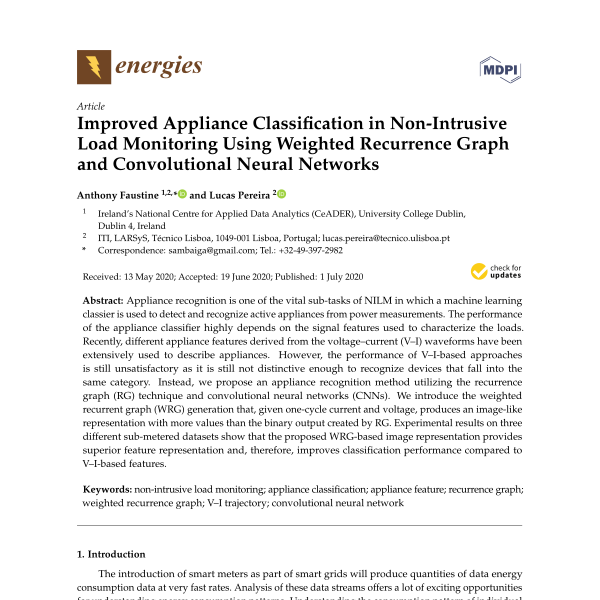
Improved Appliance Classification in Non-Intrusive Load Monitoring Using Weighted Recurrence Graph and Convolutional Neural Networks
2020
Journal
Published
Anthony Faustine and Pereira, Lucas

Improved Appliance Classification in Non-Intrusive Load Monitoring Using Weighted Recurrence Graph and Convolutional Neural Networks

Energies , Vol. 13, No. 13

Appliance recognition is one of the vital sub-tasks of NILM in which a machine learning classier is ... used to detect and recognize active appliances from power measurements. The performance of the appliance classifier highly depends on the signal features used to characterize the loads. Recently, different appliance features derived from the voltage–current (V–I) waveforms have been extensively used to describe appliances. However, the performance of V–I-based approaches is still unsatisfactory as it is still not distinctive enough to recognize devices that fall into the same category. Instead, we propose an appliance recognition method utilizing the recurrence graph (RG) technique and convolutional neural networks (CNNs). We introduce the weighted recurrent graph (WRG) generation that, given one-cycle current and voltage, produces an image-like representation with more values than the binary output created by RG. Experimental results on three different sub-metered datasets show that the proposed WRG-based image representation provides superior feature representation and, therefore, improves classification performance compared to V–I-based features.

nilm load recognition machine learning dissagregation
Full details PDF Poster Link Code DOI
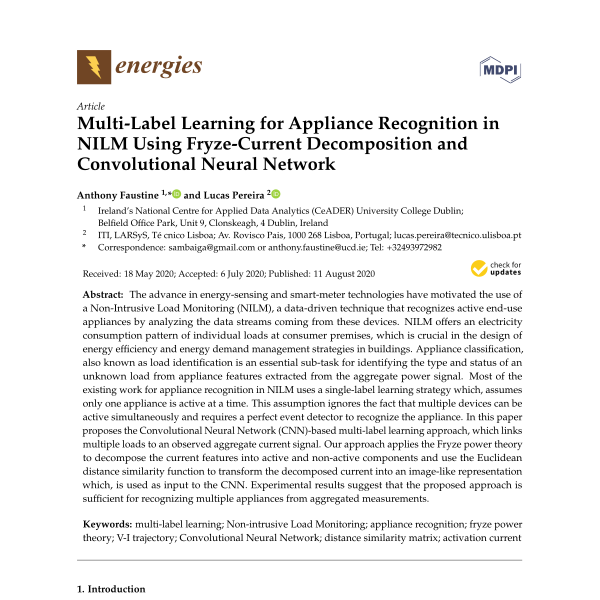
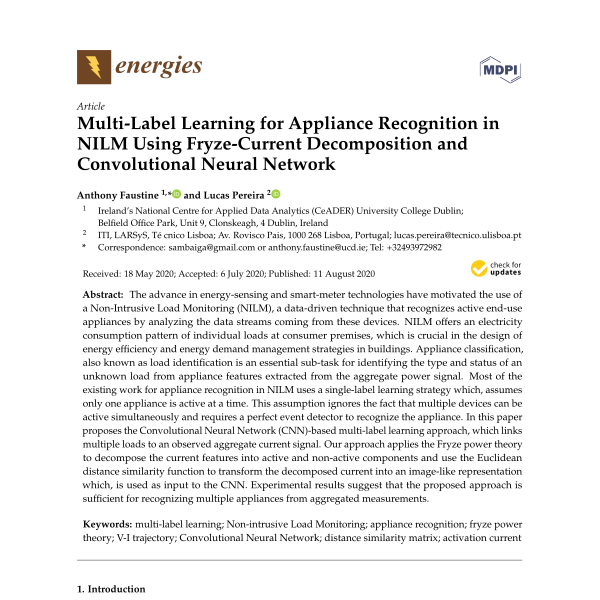
Multi-Label Learning for Appliance Recognition in NILM Using Fryze-Current Decomposition and Convolutional Neural Network
2020
Journal
Published
Anthony Faustine and Pereira, Lucas

Multi-Label Learning for Appliance Recognition in NILM Using Fryze-Current Decomposition and Convolutional Neural Network

Energies , Vol. 13, No. 16 , pp. 1996-1073

The advance in energy-sensing and smart-meter technologies have motivated the use of a Non-Intrusive ... Load Monitoring (NILM), a data-driven technique that recognizes active end-use appliances by analyzing the data streams coming from these devices. NILM offers an electricity consumption pattern of individual loads at consumer premises, which is crucial in the design of energy efficiency and energy demand management strategies in buildings. Appliance classification, also known as load identification is an essential sub-task for identifying the type and status of an unknown load from appliance features extracted from the aggregate power signal. Most of the existing work for appliance recognition in NILM uses a single-label learning strategy which, assumes only one appliance is active at a time. This assumption ignores the fact that multiple devices can be active simultaneously and requires a perfect event detector to recognize the appliance. In this paper proposes the Convolutional Neural Network (CNN)-based multi-label learning approach, which links multiple loads to an observed aggregate current signal. Our approach applies the Fryze power theory to decompose the current features into active and non-active components and use the Euclidean distance similarity function to transform the decomposed current into an image-like representation which, is used as input to the CNN. Experimental results suggest that the proposed approach is sufficient for recognizing multiple appliances from aggregated measurements.

nilm load recognition machine learning dissagregation
Full details PDF Link Code DOI
A Survey on Non-Intrusive Load Monitoring Methodies and Techniques for Energy Disaggregation Problem
2017
Journal
Published
Anthony Faustine, Nerey Henry Mvungi, Shubi Kaijage and Kisangiri Michael

A Survey on Non-Intrusive Load Monitoring Methodies and Techniques for Energy Disaggregation Problem

CoRR

The rapid urbanization of developing countries coupled with explosion in construction of high rising ... buildings and the high power usage in them calls for conservation and efficient energy program. Such a program require monitoring of end-use appliances energy consumption in real-time. The worldwide recent adoption of smart-meter in smart-grid, has led to the rise of Non-Intrusive Load Monitoring (NILM); which enables estimation of appliance-specific power consumption from building's aggregate power consumption reading. NILM provides households with cost-effective real-time monitoring of end-use appliances to help them understand their consumption pattern and become part and parcel of energy conservation strategy. This paper presents an up to date overview of NILM system and its associated methods and techniques for energy disaggregation problem. This is followed by the review of the state-of-the art NILM algorithms. Furthermore, we review several performance metrics used by NILM researcher to evaluate NILM algorithms and discuss existing benchmarking framework for direct comparison of the state of the art NILM algorithms. Finally, the paper discuss potential NILM use-cases, presents an overview of the public available dataset and highlight challenges and future research directions.

nilm machine learning disaggregation
Full details Link
Ubiquitous Mobile Sensing for Water Quality Monitoring and Reporting within Lake Victoria Basin
2014
Journal
Published
Anthony Faustine and Aloys N. Mvuma

Ubiquitous Mobile Sensing for Water Quality Monitoring and Reporting within Lake Victoria Basin

Wireless Sensor Network , Vol. 6, No. 12 , pp. 257-264

As the human population growth and industry pressure in most developing countries continue to increa ... se, effective water quality monitoring and evaluation has become critical for water resources management programs. This paper presents the ubiquitous mobile sensing system for water quality data collection and monitoring applications in developing countries. The system was designed based on the analysis of the existing solution. Open source hardware and software was used to develop the prototype of the system. Field testing of the system conducted in Nkokonjero, Uganda and Mwanza, Tanzania verified the functionalities of the system and its practical application in actual environment. Results show that proposed solution is able to collect and present data in a mobile environment.

wsn iot water quality
Full details Link DOI
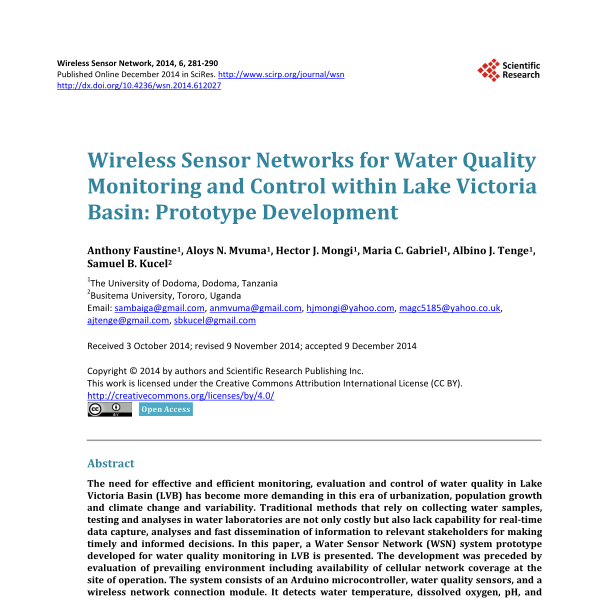
Wireless Sensor Networks for Water Quality Monitoring and Control within Lake Victoria Basin: Prototype Development
2014
Journal
Published
Anthony Faustine, Aloys N. Mvuma, Hector J. Mongi, Maria C. Gabriel, Albino J. Tenge and Samuel B. Kucel

Wireless Sensor Networks for Water Quality Monitoring and Control within Lake Victoria Basin: Prototype Development

Wireless Sensor Network , Vol. 6, No. 12 , pp. 281-90

The need for effective and efficient monitoring, evaluation and control of water quality in Lake Vic ... toria Basin (LVB) has become more demanding in this era of urbanization, population growth and climate change and variability. Traditional methods that rely on collecting water samples, testing and analyses in water laboratories are not only costly but also lack capability for real-time data capture, analyses and fast dissemination of information to relevant stakeholders for making timely and informed decisions. In this paper, a Water Sensor Network (WSN) system prototype developed for water quality monitoring in LVB is presented. The development was preceded by evaluation of prevailing environment including availability of cellular network coverage at the site of operation. The system consists of an Arduino microcontroller, water quality sensors, and a wireless network connection module. It detects water temperature, dissolved oxygen, pH, and electrical conductivity in real-time and disseminates the information in graphical and tabular formats to relevant stakeholders through a web-based portal and mobile phone platforms. The experimental results show that the system has great prospect and can be used to operate in real world environment for optimum control and protection of water resources by providing key actors with relevant and timely information to facilitate quick action taking.

wsn iot water quality
Full details Slide Link DOI
No matching items

2025–2026 Anthony Faustine All content licensed under
Creative Commons CC BY 4.0

ORCID 0000-0002-7838-533X PGP public key   Fingerprint:
49ACD41443AEBE4C4877B
573E6EBC869F77E2675

Made with Quarto View the source at GitHub