


Rank#
milia.recommend finds the cases most similar to a series, ranks them, and recommends the action that worked for them.
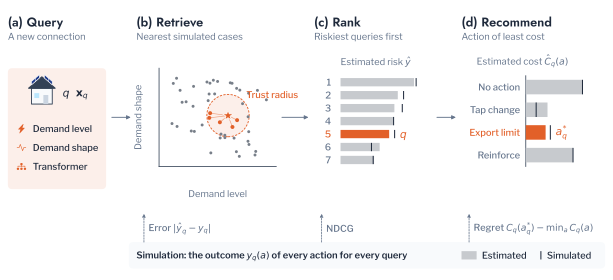
The chain of a retrieval task: a query, the nearest past cases inside the trust radius, a ranking of the queries, and the action of least cost.#
import numpy as np

from milia.data import profiles, synthetic

population = synthetic.generate(meters=60, days=90, steps=48)
shapes = np.asarray(profiles.shape(population.pivot))
outcome = population.labels.astype(float)  # a stand-in for a known outcome
Retrieve similar cases#
KNNRetriever predicts the outcome of a series from its nearest labelled neighbours. Calibrating it on held-out cases
sets a trust radius: a query that is farther than the radius from every labelled case is reported as not trusted.
from milia.recommend.retrieval import KNNRetriever

retriever = KNNRetriever(n_neighbors=3).fit(shapes[:45], outcome[:45])
retriever.calibrate(shapes[45:55], alpha=0.1, y=outcome[45:55])
queries = shapes[55:58]
retriever.predict(queries), retriever.trusted(queries), round(float(retriever.tau_), 3)
(array([1., 2., 0.]), array([ True, True, True]), 0.05)
Recommend an action#
CaseRecommender suggests the action taken most often on the nearest past cases, with ties going to the nearer one.
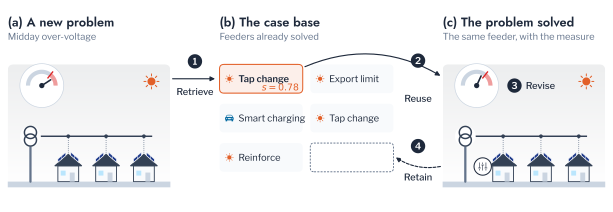
Case-based recommendation follows four steps: retrieve the most similar solved case, reuse its action, revise it for the new case, and retain the result.#
from milia.recommend.action import CaseRecommender

actions = population.labels  # the action taken on each past case
recommender = CaseRecommender(n_neighbors=3).fit(shapes[:45], actions[:45])
recommender.predict(queries)
array([1, 2, 0])
A baseline to beat#
GroupMean predicts the mean outcome of the query’s group. A retrieval method that does not beat it is not adding
information.
from milia import make
from milia.recommend.baselines import GroupMean

baseline = GroupMean(clusterer=make("clusterer", "kmeans", n_clusters=3)).fit(shapes[:45], outcome[:45])
baseline.predict(queries)
array([1., 2., 0.])
Rank cases and groups#
ranking.rank orders a table by a score, and ranking.interval adds a bootstrap interval to each rank, so a reader can
see which ranks are real.
import pandas as pd

from milia.recommend import ranking

cases = pd.DataFrame({"case": range(6), "risk": [3, 9, 1, 7, 5, 2]})
ranking.interval(cases, "risk", bootstrap=100)
| rank | case | risk | lower | upper | |
|---|---|---|---|---|---|
| 0 | 1 | 1 | 9 | 1.0 | 3.0 |
| 1 | 2 | 3 | 7 | 1.0 | 4.0 |
| 2 | 3 | 4 | 5 | 1.0 | 5.0 |
| 3 | 4 | 0 | 3 | 2.0 | 5.0 |
| 4 | 5 | 5 | 2 | 3.0 | 6.0 |
| 5 | 6 | 2 | 1 | 4.0 | 6.0 |
Limits#
Similarity is only as good as the features that define it. A retrieval over shapes cannot tell two series of different size apart, and a trust radius says a query is near the labelled cases, not that their outcomes transfer.