


Key concepts#
From series to features#
Methods in milia work on a matrix with one row per series, or per window of a series. milia.data turns a table of
readings into normalised daily profiles and day tensors, and milia.features turns those into named features: the
shape of the mean day, calendar and magnitude summaries for clustering, and shape, rolling and spectral features of a
window for anomaly detection. Features carry names, so a result can be read back in the units of the problem.
Estimators and the registry#
Every learned component is a scikit-learn estimator with fit and predict, so it clones, pickles, tunes with
GridSearchCV and composes in a Pipeline. Detectors and clusterers are registered by name:
milia.available("detector") lists them, and milia.make("detector", "lof", n_neighbors=30) builds one from its
validated configuration.
Trust before use#
A clustering is real only if it survives resampling. milia scores each candidate number of groups by internal validity and by resampling checks (prediction strength, per-cluster bootstrap and subsample agreement), and it calibrates those checks against structureless reference data, so a split that the data does not support is not chosen. A retrieval carries a trust radius, so a query that is far from every labelled case is reported as such.
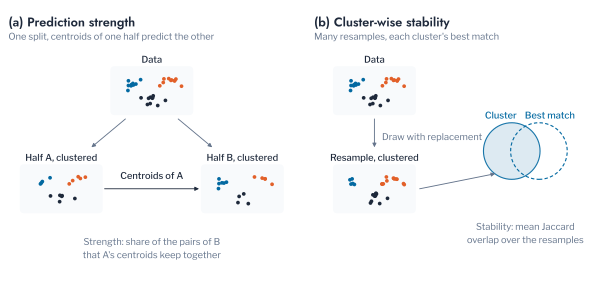
Two of the resampling checks that a clustering has to pass.#
Conformal thresholds#
Anomaly scores have no natural scale. milia sets the threshold from held-out normal data with a split-conformal
quantile, so that, for exchangeable data, the expected share of normal cases that are flagged is bounded by the level
alpha that you choose. A threshold can also be set per group, so that a group with a different normal range is held to
its own standard.
Reproducible runs#
Randomness is seeded from named conditions, and a benchmark writes a run folder with a provenance record: the settings, the package versions and the input files. Methods are compared with significance tests on per-unit results, not by a single average.